Product family

Foams

PUFOAM, LBOARD and XFOAM are three distinct foam routes, each selected for a different combination of cell structure, surface finish, weight and machining need.

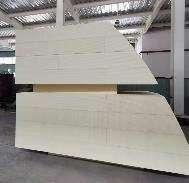
Machined PU foam blocks
EPTEK / TOOLING EXPERTISEFoams

Engineering view / Foams and lightboards

Reduce mass without losing the next process

Large models and lightweight tooling are often limited by handling, support and transport rather than geometry. A suitable foam or lightboard core reduces mass while preserving enough compression strength, dimensional stability and machinability for the next operation.

01 / CUSTOMER PROBLEM

Make large forms manageable

Lightweight cores help teams move, support and assemble large models, moulds and buoyancy structures. The trade-off is that lower density usually demands more careful sealing, local reinforcement and surface protection.

02 / SELECTION LOGIC

Separate the foam roles

Use lightweight routes for bulk and handling, finer-cell board routes where the surface is machined directly, and structural grades where compression and inserts control the design. Confirm the supplied grade instead of inferring performance from colour.

03 / PROCESS CHECKPOINTS

Plan the complete build

For large work, decide block layout, adhesive joints, lifting points, CNC datum, sealing, skin or backing structure and site assembly together. Foam, adhesive and coating must be trialed as one stack.

04 / RELEASE CHECK

Validate the environment

For marine or floating wind applications, check closed-cell behaviour, water exposure, compression, bonding and transport handling with the actual geometry and assembly method.

Plan core, bonding and machining together.Share geometry, temperature or hardness target, process route, quantity and finish requirement. The matching EPTEK TDS remains the authority for grade-specific values and handling limits.Contact us ↗

Product data

Product data

Compare PUFOAM, LBOARD and XFOAM by the role of the core, surface finish and machining requirements. PUFOAM 300D is a grade within the PUFOAM series.

02 / LBOARD

LBOARD

Fine-cell lightweight model foam

Density range
Approx. 0.25–0.45 g/cm³
Use
Direct machining for selected models and moulds
Selection note
Choose where low mass and surface quality matter
Open technical data ↗

03 / XFOAM

XFOAM

Blue foam board

Route
Machinable blue foam board
Use
Lightweight patterns and cores
Selection note
Grade selection follows the supplied technical sheet
Open technical data ↗

01 / PRODUCT FAMILY

PUFOAM

Primarily used as model or mould cores, bulk substrates and large lightweight forms. Direct machining generally needs more sealing and repair because the cell structure is less fine.

02 / PRODUCT FAMILY

LBOARD

A light “model-board” route that can be machined directly for selected models and moulds. For lightweight automotive models, LBOARD grades in the 0.25–0.45 density range provide a direct-machining route; each grade is selected from its technical data.