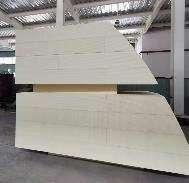
Large models and lightweight tooling are often limited by handling, support and transport rather than geometry. A suitable foam or lightboard core reduces mass while preserving enough compression strength, dimensional stability and machinability for the next operation.
01 / CUSTOMER PROBLEM
Make large forms manageable
Lightweight cores help teams move, support and assemble large models, moulds and buoyancy structures. The trade-off is that lower density usually demands more careful sealing, local reinforcement and surface protection.
02 / SELECTION LOGIC
Separate the foam roles
Use lightweight routes for bulk and handling, finer-cell board routes where the surface is machined directly, and structural grades where compression and inserts control the design. Confirm the supplied grade instead of inferring performance from colour.
03 / PROCESS CHECKPOINTS
Plan the complete build
For large work, decide block layout, adhesive joints, lifting points, CNC datum, sealing, skin or backing structure and site assembly together. Foam, adhesive and coating must be trialed as one stack.
04 / RELEASE CHECK
Validate the environment
For marine or floating wind applications, check closed-cell behaviour, water exposure, compression, bonding and transport handling with the actual geometry and assembly method.