01 / CUSTOMER PROBLEM
Release enclosed geometry
Temporary cores can remove split-tool design constraints from ducts, manifolds and difficult-release composite structures while preserving the intended internal shape.
 TOOLING MATERIALS
Product family
Water-soluble cores and mandrels are temporary internal tools for enclosed cavities, internal channels and difficult-release composite structures.
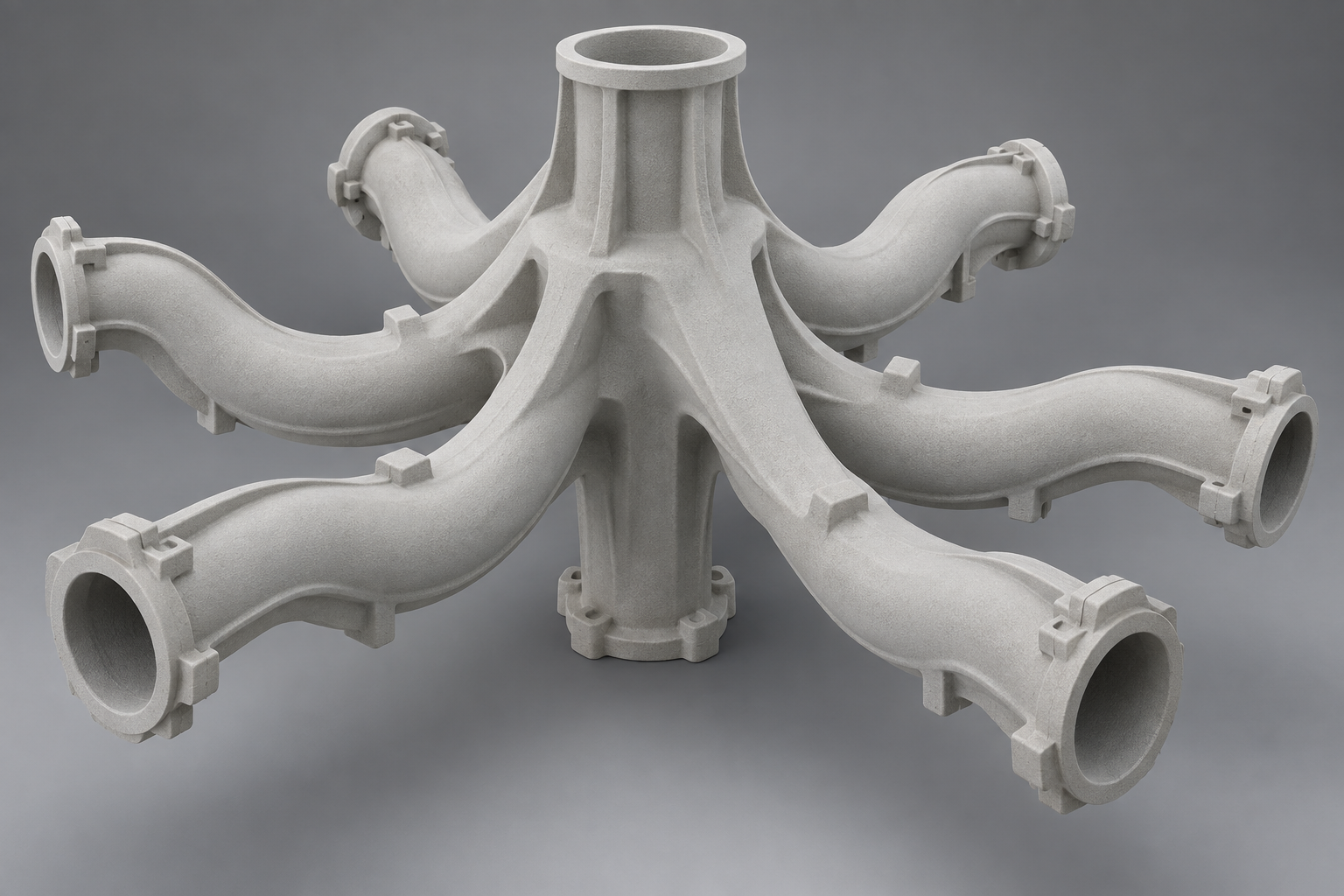
Engineering view / Water-soluble mandrels
A dissolvable mandrel makes complex hollow geometry possible without forcing a mechanical tool apart. The core must remain stable during lay-up and cure, then dissolve and flush completely through the access provided by the finished part.
01 / CUSTOMER PROBLEM
Temporary cores can remove split-tool design constraints from ducts, manifolds and difficult-release composite structures while preserving the intended internal shape.
02 / SELECTION LOGIC
Confirm access openings, drain paths, wall support, surface compatibility, cure exposure and the intended wash conditions. The mandrel is part of the part design, not an afterthought.
03 / PROCESS CHECKPOINTS
Plan handling, reinforcement placement, vacuum or pressure, cure, opening of the access path, flushing and inspection. Validate that no residue remains in corners, ribs or small passages.
04 / RELEASE CHECK
Test with the project’s resin, reinforcement, cure route and wash conditions. EPTEK does not publish a universal dissolution time because geometry and process determine the result.
01 / PRODUCT FAMILY
Water-soluble cores, also called water-soluble mandrels or wash-out mandrels, are temporary internal tools that dissolve after composite curing.
02 / PRODUCT FAMILY
Choose the mandrel form and dissolution behaviour around cavity geometry, wall support, access openings and the required washout cycle.