
Vacuum tooling
Choosing Materials for Vacuum Trimming Fixtures
A vacuum milling fixture must support the part, hold a seal and return to a repeatable machining datum. Cast aluminium is a useful baseline, but three non-metal routes can be better when their complete cost and thermal behaviour fit the duty cycle.
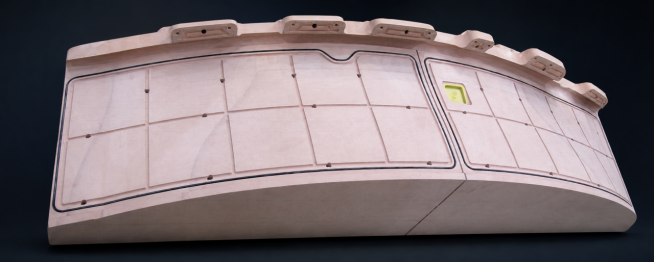
A vacuum milling or trimming fixture is a structural and sealing system, not just a shaped plate. Its face supports the part, its grooves and ports hold vacuum, and its base establishes repeatable location for machining and inspection. Cast aluminium remains the reference because its stiffness, interfaces and thermal response are familiar. Three non-metal routes—bonded tooling board, precision-cast tooling resin, and a gel-coat/composite skin replicated from a qualified master—can also work. The right comparison is the total risk and cost at the required accuracy, temperature and duty cycle.
What cast aluminium does well
Common aluminium alloys and cast grades have a room-temperature CTE of roughly 23–27 × 10−6/K; confirm the actual grade and temperature range for a project. Aluminium conducts heat quickly and provides a uniform, stiff body with dependable threads and interfaces after casting, stress relief and CNC finishing. Those traits suit high-frequency use, wear and fixtures with many connections.
The route is not simple, however. It normally includes a pattern or casting tool, casting, inspection, stabilization and extensive machining. Porosity can become a vacuum-leak path and may require impregnation or sealing. The pattern, machine time, tooling, lifting and later modifications all add cost. That investment can be rational when the fixture runs often and wears heavily; scrap aluminium also has an established recovery value.
Three non-metal routes and where their value comes from
Bonded tooling-board machining
PUBOARD or EPBOARD is cut into blocks or layers, bonded, datum-machined and then milled for the face, seal grooves, vacuum ports and mounting references. Factory-cured board gives consistent machining behaviour. The source places common board CTE around 40–55 × 10−6/K, so a controlled-temperature shop and a realistic thermal budget are necessary. For small and medium fixtures, low cutting resistance makes the route quick to modify: a local repair can be bonded and re-machined, without making a new casting pattern. Every bond line must be fully wetted, cured and sealed; a joint left open is a potential leak and a local compliance change.
Precision-cast tooling resin
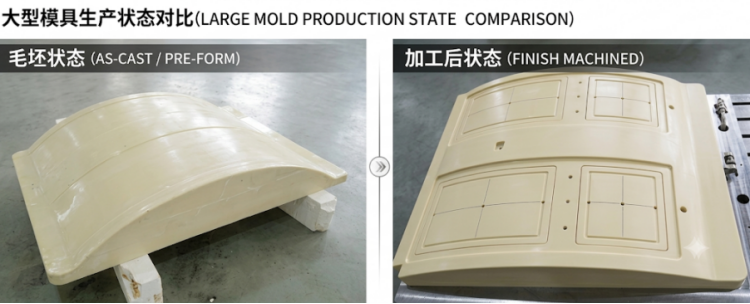
PUCAST or EPCAST can be poured into a shaped cavity to make a near-net blank, followed by final CNC machining. The absence of through-board seams simplifies the air path, and the blank can be much closer to the finished envelope than a thick stack of plate. The economic case comes from less stock removal and less metal machining—not from filling a large fixture with an unnecessarily thick block of resin. The complete fixture should pair the continuous, machinable work body with a metal base, mounting blocks or a back frame that carries lifting and installation loads.
Gel coat, glass-filled paste and composite backing
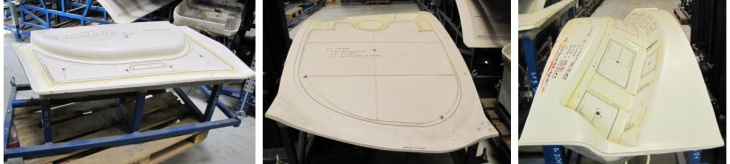
If a qualified master already exists, a thin gel-coat work face can be replicated and supported with glass-filled paste or a glass- or carbon-fibre/epoxy structure. This is attractive when several fixtures are needed from one master: copying reduces stock removal and keeps the envelope light. For one fixture, the cost of making and qualifying the master can erase that advantage. Offset must include the part's nominal cure thickness, springback and the installed datum.
EPMOLD LP70 is a useful example of why test conditions belong in the specification. The cited CTE is 25 × 10−6/K for a standard specimen post-cured at 60 °C for 16 hours and tested from 20 to 50 °C. A balanced carbon-fibre/epoxy backing can reduce in-plane expansion and add bending and torsional stiffness, but the final assembly still depends on ply direction, paste and adhesive layers, local inserts, post-cure, demoulding and the base connection. High-accuracy faces may need a final datum-based skim, seal-groove machining and a leak check after installation.
Use a thermal budget, not a material slogan
For a free, uniform five-metre length, the first estimate is ΔL = αLΔT. The values below are theoretical expansion only; they are not installed shape error.
| Material or structure | Typical CTE (×10−6/K) | 5 m, +1 °C | 5 m, +5 °C |
|---|---|---|---|
| Common aluminium/cast aluminium (grade dependent) | 23–27 | 0.12–0.14 mm | 0.58–0.68 mm |
| EPMOLD LP70, post-cured test specimen | 25 | 0.13 mm | 0.63 mm |
| Common tooling board or cast tooling resin (grade dependent) | 40–55 | 0.20–0.28 mm | 1.00–1.38 mm |
| Designed CFRP panel, in-plane direction | 0–5 | 0–0.03 mm | 0–0.13 mm |
Uniform temperature mainly changes overall size. Gradients and CTE mismatch between the work layer, adhesive, composite backing, metal base, support points and seal reaction are more likely to create local warp. Set the allowed temperature difference from fixture length, datum scheme and error budget, then let machining, use and inspection reach the same reference temperature.
Qualification and selection
- Check work-face geometry against the base datums, then measure evacuation time in each zone and pressure rise after isolating the vacuum source.
- Install representative parts to check fit, seal compression and the first machining result.
- For replicated composite fixtures, record geometry after initial cure, demoulding, post-cure, mounting and a controlled temperature cycle.
Choose bonded board when a small or medium fixture is changing often and the temperature can be controlled. Choose precision casting when a larger, seam-free near-net blank will reduce machining and the base can carry the loads. Choose a gel-coat/composite shell when a qualified master can be reused across multiple fixtures and the backing and interfaces are designed symmetrically. Retain cast aluminium when high cycle count, wear, threaded interfaces and mature maintenance outweigh the non-metal schedule or weight benefits. In all cases, compare actual material volume, utilization, machining, sealing, lifting, rework, repair and modification; a non-metal route only earns its place when that full total is lower at the same acceptance criteria.