
Precision tooling
Close-Contour Casting for Models and Fixtures
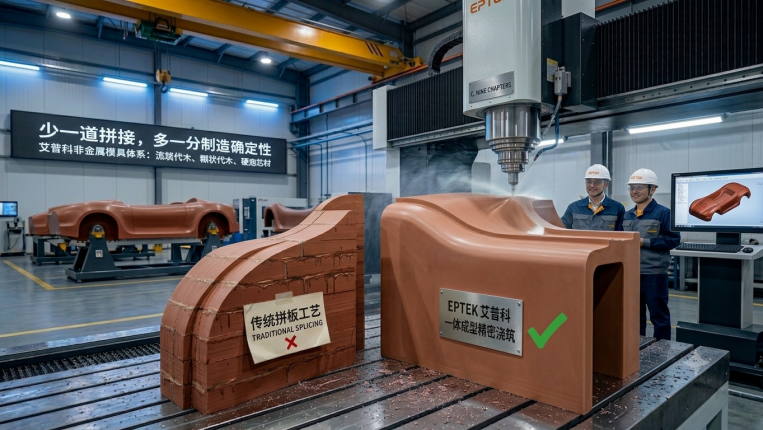
Close-contour casting changes the starting geometry of a tool. Instead of machining a large rectangular stack and repairing its seams, the process designs a cavity around the final contour, then machines only the controlled allowance that remains.
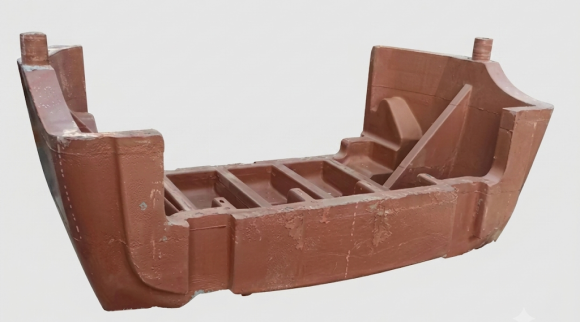
Large models and tools with deep pockets or irregular contours can require complex assemblies of tooling board. Each cut, adhesive layer and repair adds another interface to manage. Close-contour casting, a near-net manufacturing method,starts with the three-dimensional product data and creates a continuous cast blank that follows the intended shape, leaving a measured allowance for CNC finishing.
Why seams become a manufacturing variable
Standard board stock remains practical for small, simple parts and urgent modifications. As size, depth and surface expectations rise, its seams create four linked issues. Adhesive and board differ in colour, hardness, thermal expansion and sanding behaviour, so a repaired joint can reappear under a high-gloss finish or after temperature cycling. A partly bonded edge or hidden cavity can become a leak path in a vacuum tool. The adhesive layer is also a discontinuity that may debond, crack or form a step under handling, vacuum load or repeated temperature changes. Finally, cutting rectangular stock removes material that never belonged to the finished contour.
A workflow built around the final contour
- Import and plan the data. Define the finished surface, machining allowance, datums, inserts, vacuum zones and mounting structure. The allowance must be large enough for stabilisation and finish machining but small enough to preserve the benefit of a near-net blank.
- Build the cavity. CNC-machine a foam or other sacrificial cavity that tracks the part data. The cavity controls material volume and places feed, vent, insert and support features before resin is mixed.
- Cast and cure. Fill the cavity with a PUCAST or EPCAST system selected for the section, temperature and finishing route. Thick walls may need staged pours, controlled exotherm and a defined post-cure. The cast body should cool in a controlled way before release.
- Stabilise, then machine. Remove the blank, inspect it, and sequence roughing, stabilisation, reinspection and finish CNC or five-axis machining. Add datum holes, vacuum grooves, seal channels, locating pins and metal inserts from the same controlled reference.
- Seal and verify. Close the surface porosity, check seal continuity, run zoned vacuum and pressure-rise tests where relevant, and compare the working contour to the drawing or point cloud at the reference temperature.
Route comparison
| Route | Where precision comes from | Useful fit | Trade-offs to manage |
|---|---|---|---|
| Bonded board stack | Stable assembly followed by CNC | Small or medium tools, short lead times, frequent changes | Joint sealing, seam repair and low material utilisation on deep shapes |
| Close-contour cast blank | Continuous body stabilised before CNC | Medium or large complex contours and vacuum work | Cavity fabrication, heat release, shrinkage, void control and post-cure |
| Thin copied skin with composite backing | Master-model replication, then selective machining | Large surfaces with an existing master and low mass requirement | Demould springback, layered CTE mismatch and support stiffness |
Cost means the whole route
A fair comparison cannot stop at resin or aluminium price per kilogram. Count the usable blank volume, material yield, cavity fabrication, CNC hours, cutters, adhesive and sealing work, base plates, lifting, vacuum tests, rework, maintenance and future changes. Close-contour casting has an upfront cavity cost, but its allowance can reduce roughing and chips, and the continuous body removes many seam-preparation operations. A board stack can still be the economical choice for a small, regular, one-off component or a design that is likely to change. For a large irregular tool, the relevant question is whether the saved machining and repair work outweigh the cavity and casting controls.
Automotive models and fixtures
In styling and master models, a continuous blank helps carry the digital surface into large exterior panels, bumpers, wings, grilles, lamps and aerodynamic features without a board joint crossing a high-gloss review area. The result still depends on machining, sealing, paint and measurement; casting alone does not certify an A-surface.
Data-control and Cubing models use the same approach for gap, flush, boundary and assembly checks. Edges and datums can be machined into the cast body, while locating pins, inspection blocks and metal inserts are added from the controlled coordinate system. For interiors and small-batch tooling, the blank can support dashboards, door panels, consoles, pillars, headliners, seats, luggage trim and battery-vehicle covers. The same platform can feed vacuum-forming, low-pressure RIM, foaming and soft-trim tools when the selected material and thermal cycle are compatible.
Contour gauges, positioning fixtures, assembly supports and measurement bases benefit from a near-net support shape: the body carries the part contour and the final machining establishes repeatable datums. Keep service access, replaceable wear blocks and fastener interfaces in the design; removing seams does not remove the need for maintainable fixture details.
Transfer to aerospace tooling
For composite transition moulds, vacuum trimming fixtures and sheet-metal forming blanks, the same sequence creates a continuous support body before five-axis finishing. Material choice must follow cure temperature, thermal cycling, CTE, hardness and compatibility with sealers or gel coats. Vacuum tools still require surface sealing, continuous gasket checks, zoned vacuum tests and a whole-tool hold test.
Close-contour casting is therefore a manufacturing route, not a blanket replacement for board stock or metal. Specify the contour, allowance, reference temperature, verification method and repair strategy up front. Then compare the complete process cost and risk for the intended model, gauge or fixture.